Working thesis
The most promising starting point is a bounded commercial workflow that becomes economical when robots can handle variation and recover from mistakes. Buy the robot hardware and reuse available models; own the application, deployment process, customer relationship, and evidence of reliable performance. Use fixed automation where it works, learned manipulation where variation matters, and mobility only where it improves the economics.
This is a provisional startup thesis, not a claim that a particular market has been validated. The research question is: what can a San Francisco startup demonstrate with $10–15 million before it needs substantially more capital, and what could that initial product expand into? A billion-dollar valuation is an ambition, not an outcome implied by model progress. The relevant intermediate achievement is repeatable deployment with attractive customer economics and a defensible route to a much larger revenue base.
Research status, 20 November 2026. This document combines the author’s supplied opportunity notes, primary research papers, official product documentation, vendor announcements, and independent benchmark operators. No customer interviews, physical experiments, supplier quotations, or investor conversations have been conducted for this draft. Recommendations, budgets, business models, and thresholds below are proposed hypotheses. Vendor demonstrations and reported deployments are identified as such; they do not establish independently audited uptime or profitability.
Starting from work that people need done
The original notes distinguish consumer applications, business applications, and infrastructure: cooking, dishes, laundry, cleaning, mowing, care, transportation, construction, and the components needed to build robots. They also propose a valuable design principle: adding an inexpensive motor or interface to a dishwasher may be more economical than teaching a general robot to operate an awkward door and rack.
The unit of analysis should be the completed workflow, including preparation and cleanup. A laundry robot that folds a staged towel still leaves collection, sorting, untangling, loading, transfer, quality checks, and putting away. A robot that picks an item still needs to identify the correct order, inspect its condition, handle packaging, and reconcile inventory. Removing one motion is valuable only if it removes paid work, increases useful throughput, or solves a constraint that customers will pay to remove.
For each opportunity, ask: how frequently is the work performed; what does failure cost; who pays today; how much can the environment be standardized; and can the same installation be sold repeatedly? Household time is evidence of burden, not of willingness to pay. The BLS reports 1.99 hours per day of household activities in its 2025 time-use averages, but this aggregates many activities and people. It is not the number of hours a household robot could replace.[1]
Choosing the body after choosing the job
| Architecture | When it is a sensible first choice | Cost of choosing it unnecessarily |
|---|---|---|
| Dedicated appliance, fixture, or conveyor | The sequence and geometry repeat; objects can be presented consistently | Limited flexibility, but often the lowest operating complexity |
| Fixed arm or paired arms | Variation is concentrated at one workstation | Reach limitations and material transfer between stations |
| Wheeled mobile manipulator | Several nearby stations must share manipulation capacity on accessible floors | Navigation, docking, charging, traffic, and travel time |
| Humanoid or legged platform | Steps, human infrastructure, or reach requirements justify the body | Balance, power, mechanical complexity, and service requirements |
| Hybrid cell | Conventional equipment can do most processing while a robot handles variable loading and exceptions | Integration and responsibility across equipment suppliers |
These are design judgments, not a universal ranking of robot forms. Compare total delivered cost and accepted output at a real site. A cheap robot arm can become an expensive system after integration; an expensive robot can be economical if it avoids substantial site reconstruction.
What the models change
Vision-language-action models and generalist agents
A vision-language-action model (VLA) maps visual observations and instructions, often together with robot state, to physical actions. OpenVLA provides an early open reference: a 7-billion-parameter model trained on 970,000 robot episodes, with a pipeline for adapting it to new setups.[2] Physical Intelligence’s π0 uses a vision-language backbone with a continuous action expert; its subsequent π0.5 work addresses operation in previously unseen environments.[3][4]
A generalist multimodal language model can instead inspect camera images, write control code, call a motion API, and evaluate the result. The distinction is architectural rather than absolute: a language model can supervise a VLA, and a VLA can incorporate high-level reasoning. The important comparison is the whole deployed system, including perception, available tools, calibration, training, recovery, latency, and human assistance.
Physical Intelligence’s π*0.6 research explicitly addresses learning beyond demonstrations, using autonomous experience and human corrections. It reports throughput increases and reduced failures on selected tasks.[5] That supports a strategy of learning from deployments, but it does not show that every task becomes reliable after a small fine-tuning run. The public OpenPI repository provides reusable policy code and checkpoints; availability, hardware fit, and the licenses of each dependency and checkpoint still need review for a commercial implementation.[6]
The recent generalization evidence
The author’s observation is supported by RoboDojo-RC Tier 1, a real-robot benchmark with 120 attempts per configuration, capped at 40 model calls for language models and 3,600 control steps for VLAs. Its current results include:[7]
| Configuration | Mean progress score | Estimated cost / attempt | Minutes / attempt |
|---|---|---|---|
| Gemini 4 Argon, high / priority | 48.2% | $2.34 | 20.5 |
| Gemini 4 Carbon, high | 54.5% | $2.16 | 32.1 |
| Claude Fable 5.2, high / fast | 57.5% | $5.93 | 4.5 |
| GPT-6.2 Astra, high / ultrafast | 65.7% | $10.51 | 2.7 |
| Dream-1, hosted robot policy | 59.5% | $0.15 | 1.5 |
These are partial-credit progress scores, not task success rates. Language-model times are wall-clock; the robot-policy time is time to its final score. Costs use different inference services. The table shows a capability–cost tradeoff, not a production price list.[7:1]
The operator selected Tier 1’s six tasks from the easiest tasks for an earlier GPT-6 Astra evaluation. That selection limits broad generalization claims.[8] These results motivate physical testing; they do not establish performance on moving warehouse lines, arbitrary homes, fragile objects, or an entire shift. Reproduce the relevant task before selecting a production model.
Anthropic’s 9 November release reports 64.9% on RoboDojo Sim at maximum effort, compared with 29.8% for GPT-6 Astra in its internal runs, alongside physical robot demonstrations. Keep this simulated benchmark separate from the real-robot table above.[9] Google’s 17 November robotics post describes Argon and Carbon controlling arms through camera input and code, and introduces Hydrogen plus an Antigravity robotics workbench for setup, simulation, and application development.[10] The implication for a startup is two-sided: faster prototyping, but less defensibility in a product whose only function is connecting an LLM to an arm.
OpenAI’s GPT-6.2 announcement establishes the release and broader agentic improvements; the robotics comparison here comes from Robocurve rather than from assuming that coding scores imply manipulation ability.[11]
Capability is not yet an operating margin
Artificial Analysis’s initial AA-Robotics v0.1 release on 14 October tested eight tabletop tasks with a six-axis arm and coding-agent harnesses. It gave partial credit and reported GPT-6 Astra averaging about 30 minutes and $16.36 of inference per task. Those are earlier-model, benchmark-specific measurements, not estimates for GPT-6.2 or for an optimized deployment.[12]
The newer real-robot results above show why the October measurements should not be projected forward unchanged. Even so, the proposed startup architecture separates expensive reasoning from repeated motion. Use frontier models for initial configuration, task decomposition, new-object interpretation, debugging, and bounded recovery. Use validated motion primitives, conventional control, or a locally running learned policy for routine execution. Google’s on-device robotics research demonstrates that local execution is an explicit research direction.[13]
Physical Intelligence’s real-time action-chunking research also addresses a practical issue: new action sequences must remain consistent with motion already in progress. Its experiments report improved throughput under inference delays; simply smoothing incompatible trajectories is not a reliable solution.[14]
A proposed production stack is: customer work order → workflow state machine → perception and task policy → motion controller → robot and fixture. Independent sensing verifies completion. A separate control path enforces movement limits and stops; uncertainty triggers an approved recovery or human intervention. Log observations, commands, model versions, elapsed time, failures, interventions, and the customer’s acceptance decision. A model saying it succeeded is not sufficient evidence that the work is complete.
What we must test ourselves
Evaluate a conventional automation baseline, a prompted frontier agent, a task-adapted VLA, and a hybrid system on the same physical work. Freeze hardware, item presentation, quality criteria, and test budgets. Keep a held-out set of objects, layouts, and sites, with no demonstrations from those test conditions. Record every attempt and all human preparation.
Measure accepted units per scheduled hour; damage and rework; intervention minutes per accepted unit; installation person-hours; recovery success; inference cost; and availability including cleaning, charging, and maintenance. Separate failure detection from recovery: a system that quietly damages inventory can appear more autonomous than one that correctly asks for help. Report sample sizes and uncertainty. A short, successful demo cannot establish rare-event safety or long-duration reliability.
Separate the customer from the business shape
Consumer applications sell household convenience, time, or independence. They must fit household willingness to pay, intermittent utilization, domestic layouts, and a support model that cannot assume a technician lives nearby. Commercial applications sell accepted throughput, capacity, quality, or measurable labor savings to an operating buyer. They can concentrate utilization and standardize inputs, but procurement, integration, and maintenance become part of the product. A commercial laundry plant and a home folding appliance are therefore separate businesses even if they share a manipulation policy.
Infrastructure sells to robot builders, equipment makers, or integrators. Its customer is not necessarily the end user of the robot. An application team should not assume that an internal tool or custom gripper has a standalone market merely because it was useful to build.
One-off projects versus products that can repeat
There are four distinct delivery choices. They apply within both consumer and commercial markets rather than forming another list of robot tasks.
- Custom one-off integration. The customer funds a site-specific machine and engineering. This can be a sound services business and a source of learning. It scales mainly by adding engineering capacity unless designs and installation become reusable. A seed-stage pilot may look like this; the next installations must demonstrate a change in that relationship.
- Repeatable configurable systems. The startup supports a bounded family of items, equipment, fixtures, and site layouts with a common hardware design and software release. This is the preferred commercial starting point. A new customer should select supported options rather than commission a fresh robot.
- Standardized products. A household appliance, gripper, or controller ships as a SKU with bounded setup. Manufacturing yield, distribution, returns, and support drive scale. Household variability can quietly turn an apparent product into a custom installation business.
- Managed services. The company charges per accepted unit, hour, or subscription and retains operational responsibility. This is a commercial and financing model layered over the first three, not proof of repeatability. Remote operators and field technicians must appear in the cost model.
For the first three customer installations, track the share of common hardware, custom engineering hours, deployment person-days, customer-specific software branches, retraining effort, and support minutes per accepted unit. Proposed gates are one maintained software release, no new robot mechanical design for site three, and materially lower installation effort than site one. These are hypotheses to test, not established industry thresholds. Accepting paid customization is sensible only when it teaches something reusable or is priced as services rather than hidden inside product margin.
Commercial applications: ranked fields to pursue
The ranking assumes a software and robotics team with no exclusive customer access, proprietary manufacturing process, or privileged dataset. It favors a clearly budgeted pain, an observable acceptance test, a constrained first deployment, and expansion through similar customers. The main evidence gap is customer economics: no interviews or comparative installation quotes have yet been obtained. High social need, an impressive demo, and a large market forecast do not substitute for those inputs.
Commercial rank 1: returns inspection and repacking for restricted hard goods
Proposed product. Start with a cell that identifies, visually inspects, reorients, and reboxes one retailer’s small, rigid, non-electrical home goods at a returns center. This is a proposed initial scope, not a discovered customer gap. Use a limited SKU set, approved packaging, and explicit human escalation for damage or uncertain disposition; do not promise automatic resale grading of arbitrary returns. Pair robot actions with barcode, weight, and visual checks and a warehouse-management integration. Exclude unknown liquids, sharps, and arbitrary mixed refuse from the initial operating envelope. The buyer is the site operations leader with a quantified labor or throughput problem; the economic sponsor may be central automation procurement.
Why improved models matter. Variation in labels, item orientation, packaging, and instructions can make a generalist perception-and-reasoning layer useful. Fine-tuned skills handle routine actions. Fixed fixtures, conveyors, and established robot arms should be the default. A mobile base is justified only when travel and sharing improve utilization. Handling exceptions is attractive precisely because standard automation already handles much of the predictable flow—but this also creates a trap: the residual work may be too infrequent to support a dedicated robot.
Competition and entry requirement. Ambi already sells AI-based sorting and stacking; Plus One’s Yonder already provides human supervision of robotic exceptions.[15][16] GXO’s commercial Digit agreement also demonstrates hybrid material handling involving existing logistics equipment.[17] Generic “AI picking” and generic teleoperation are not empty markets. The opportunity must be a customer-defined gap in these solutions, supported by an actual rejected automation quote or a documented unresolved workflow.
Defensibility and expansion. Own the acceptance criteria, failure and recovery dataset, integration with inventory systems, and deployment recipe. Expand from one item family to adjacent work at the same customers. Data is an advantage only when collection rights, labels, and demonstrated improvements exist; a video archive alone is not a moat.
First test and rejection criterion. Observe representative shifts at three candidate sites before building. Measure the volume, human handling time, item distribution, and error cost for the exact target process. Reject a site if its annual recoverable value cannot cover the system and support, or if the “exception category” consists mostly of unrelated one-off tasks. Reject the product direction if each second installation needs a new mechanical design or extensive bespoke policy training.
Why first. It offers an identifiable operating buyer, machine-checkable identity and packaging outcomes, concentrated work, and an expansion path through the same retailer’s network. It also avoids beginning with food-contact equipment, domestic service calls, or deformable textiles. Those are engineering advantages, not evidence of willingness to pay. The major uncertainty is whether this restricted item set leaves enough paid work after cheap fixtures and existing equipment are considered. Confidence in the ranking is moderate as an engineering hypothesis and low as a validated business.
Commercial rank 2: dishroom handling in institutional kitchens
Specific entry point. Sort and load a restricted set of reusable plates, bowls, and trays at a campus or corporate cafeteria with existing washing equipment. Begin with standardized serviceware and a fixed station. Leave washing to a proven dishwasher; compare robotic handling with guides, conveyors, magnets, and changes to tray presentation. Initially exclude glassware, knives, and arbitrary restaurant cookware. The purchaser is the food-service operator or facilities organization, potentially through its equipment dealer.
Why second. The hypothesis is repeated daily work in a controlled footprint, with less item variation than a household kitchen and a natural route to multiple sites through an operator. The author’s powered-door and guided-rack idea belongs here as a design choice. It is not necessary to sell a general humanoid to sell this outcome. Dirty-side handling, food residue, breakage, cleaning, and meal-time peaks make the task harder and utilization less continuous than a tabletop demonstration suggests.
The existing alternative is substantial. HOBART already describes automatic separating, loading, and clean-side handling systems. MEIKO offers the M-iFlow IPB automation module; MEIKO/Yaskawa demonstrations also show robot-based tray clearing. This is not an undiscovered category.[18][19][20] The candidate gap is a smaller or more easily retrofitted installation for sites poorly served by complete automated lines. That gap has not been established by this research.
Product and decision test. Sell one installation kit supporting a small equipment family, plus maintenance, rather than redesigning every dishroom. Observe three sites and obtain quotes for their conventional alternative. Measure whole-shift accepted dishes, retained scraping/loading labor, breakage, washdown time, and the footprint. Reject if the best incumbent system already wins on delivered cost, if cleaning cancels labor savings, or if integration requires a different layout every time. Confidence is low until an underserved site class is identified; it ranks second for a focused discovery sprint, not for immediate company formation.
Commercial rank 3: textile feeding and transfer in commercial laundry
Laundry combines frequent work, deformable objects, and potentially concentrated demand. Start with an operator’s bottleneck—such as feeding difficult items into existing processing equipment or transferring a constrained textile category—not a general promise to fold everything.
The competitive update matters. Dyna’s September 2026 Dyna-2.1 material uses hotel laundry as an example of an end-to-end mobile manipulation workflow. Weave says its stationary Isaac 0 is shipping in California. Laundry Robotics offers purpose-built textile handling systems.[21][22][23] These are distinct approaches, and this draft has not audited their customer economics. Nevertheless, “laundry is unsolved” is too broad to be an investable thesis.
Possible opening. A specific item class, plant size, deployment footprint, or integration that existing suppliers handle poorly. Compare with a mechanical feeder and folder, not only with humans or humanoids. Charge per accepted piece or a capacity subscription, with agreed fold quality, damage, sorting accuracy, and intervention limits.
First test and rejection criterion. Shadow operators across several shifts and classify every intervention. Measure the complete flow from unprepared input to acceptable output; count the human who separates garments or stacks the output. Reject unless a buyer can name a significant gap in available products and the pilot can close it at lower delivered cost. It ranks below dishroom handling because deformable-object recovery adds uncertainty and the direct robot competition is already substantial. A strong laundry customer relationship or a clearly unmet feeder requirement could reverse ranks 2 and 3.
Commercial rank 4: construction inspection and verification
Start with one repeated check during construction—for example, comparing a defined class of installed work against an approved plan—and deliver a traceable report that changes a payment, rework, or scheduling decision. Begin with the least complex capture method that works; a handheld camera or wheeled inspection rig may beat a manipulator. Dusty’s layout workflow and Gecko’s asset inspection business illustrate the value of a specific deliverable, while also demonstrating existing competition.[24][25]
This ranks below the first three because changing sites, mobilization, access, and project-based purchasing can defeat repeated deployment. It moves up with a committed contractor who repeats the same work across many projects. Reject if the report does not trigger a paid decision or if manual capture plus software offers the same value. Whole-house construction, general robotic trades, and a new house-printing factory are separate capital and operations programs; the notes’ concerns about printed-home adoption remain unverified rather than assumed facts.
Commercial rank 5: constrained food preparation and assembly
A centralized meal producer could buy consistent portioning or placement of a restricted ingredient set. Use fixed conveyors and equipment for predictable work; reserve learned manipulation for variation that existing systems handle poorly. Chef Robotics already sells adaptive meal assembly, so a generic version is directly competitive.[26] A credible entry needs a named unmet requirement such as a particular ingredient, sanitation process, or production footprint, and customer evidence that current suppliers cannot meet it economically.
It ranks fifth because sanitation, cleaning downtime, food variability, and established alternatives compound before a new entrant has distribution. Reject if the claimed savings exclude preparation or cleaning. A founding team with food-equipment expertise and signed plant access could reasonably move this above the other fields; without that advantage, it should not consume the initial prototype budget.
Consumer applications: a separate ranking
The ranking below assumes the objective is a consumer robotics company rather than the fastest route to a commercial pilot. It favors a bounded product over an arbitrary household task list. Household willingness to pay and willingness to prepare inputs remain unmeasured. Each entry must compare against the appliance, cleaner, laundry service, or human help a household actually uses.
Consumer rank 1: a stationary laundry-folding appliance
First product. Accept a declared subset of clean, dry textiles at a known input location and return an inspectable folded output. Start with a stationary device; transport around the home is a separate capability. Count the time required to separate, orient, and retrieve items. A machine that demands individually staged garments may save little time despite excellent folding.
This leads the consumer list because its work can be concentrated in a bounded station, a limited textile envelope can be disclosed, and the appliance can potentially ship repeatedly. It is not an empty market: Weave says Isaac 0 is shipping in California, and a new entrant must establish a specific advantage over it and over outsourced laundry.[22:1] The validation is paid household demand at a price that covers manufacturing, failures, returns, and support, followed by unassisted in-home trials. Reject if prep consumes most of the benefit or the business depends on unlimited remote labor. Expansion could include more textile categories or laundry transfer, but should not be promised in the first SKU.
Consumer rank 2: dishwasher loading and unloading with appliance adaptation
Treat the dishwasher, rack, countertop staging area, and robot as one system. Powered access, standardized dish placement, and known appliance state may remove much of the manipulation burden. The initial scope could be clean-side unloading into nearby standardized storage, then progressively harder dirty-side loading. Evaluate both before selecting one; their value and failure modes differ.
It ranks below stationary laundry because wet and fragile objects, cabinetry, rack geometry, installation, and appliance compatibility complicate a repeatable consumer product. Dishcare’s integrated approach is a relevant competitor.[27] The strongest business may be an appliance OEM partnership or a retrofit for one appliance family, not a universal home robot accessory. Reject if every kitchen requires bespoke cabinetry or if useful savings require users to prearrange every dish. Standardize a kitchen interface only if customers will accept the associated behavior change and installation cost.
Consumer rank 3: bounded cleaning beyond floors
Choose one inspectable surface task, such as cleaning a compatible shower enclosure or clearing and wiping a designated counter. These are alternative product hypotheses, not features to combine initially. Grime, contact force, edges, liquids, clutter removal, and verification all belong in the test. Whole-home cleaning should remain a later ambition.
Cleaning ranks third because demand may be frequent but the environment is less easily standardized than an appliance station. The product must beat a simpler cleaning tool after setup, replenishment, and cleaning the robot itself. Reject if it only works on an already cleared surface that takes nearly as long for a person to wipe. A commercial facilities customer may be a better first buyer, but that would be a different market thesis and service model.
Consumer rank 4: constrained cooking
Pursue a bounded appliance workflow with a limited menu and clearly specified inputs before general manipulation of knives, hot cookware, and arbitrary ingredients. Include ingredient preparation and cleanup in the saved-time calculation. The ranking is below cleaning because the sequence is long and failure can spoil an entire meal; diet preferences and kitchen layouts further fragment the product. Reject if users must do most of the preparation or if a conventional appliance meets the same need at much lower cost. Commercial food assembly is separately ranked above because its buyer, utilization, and input control are different. A personalized meal subscription produced in a shared robotic kitchen is a separate direct-to-consumer business, not an in-home appliance; the economics section evaluates it against both meal delivery and personal-chef services.
Consumer rank 5: lawn care with a specific unmet requirement
Mowing is relatively bounded, but that does not by itself create a new VLA-driven company. Identify a task or terrain that current products cannot serve economically, and test it against those products. The ranking is low for a new generalist robotics startup because a differentiated entry has not been identified here—not because mowing is intrinsically less tractable than cooking. This draft has not completed a current mower supplier comparison; a specific founder insight could change the rank. Avoid adding manipulation merely to make a mower look more general.
Consumer rank 6: non-contact assistance for older adults
Restrict an initial product to fetching approved objects or carrying supplies, with explicit limits and a human fallback. Lifting people, medication administration, and clinical decision-making are different products. Need alone does not identify the payer: the household, care provider, and insurer can have different interests. Rank this below chores until users and caregivers establish useful tasks, tolerable response time, and willingness to pay without assuming that the robot replaces a caregiver. A care-facility deployment belongs in a separate commercial evaluation rather than being counted as consumer validation.
Defer general helpers, physical baby care, and transport platforms
Sunday’s Memo, Weave’s Isaac, and 1X’s NEO are relevant home-robot references, but the notes do not establish which company the author had in mind. Sunday describes purpose-built hardware and a late-2026 beta; 1X describes an Expert Mode for unfamiliar chores.[28][29] These companies should be tracked as competitors and potential platforms, not assumed to provide an affordable supported developer fleet. A new company with this seed budget should first own one completed job rather than compete on the entire home-helper promise.
Defer autonomous physical baby care because of its exceptionally low tolerance for failure and difficult validation. Keep cars, trucks, and buses in an independent transport category, as in the original notes. They require distinct autonomy, vehicle, deployment, and market-access programs. A subsystem with an identified buyer could be seed-compatible; a full transport platform is outside the recommended initial scope.
Infrastructure: ranked separately from applications
This ranking assumes access to robot or equipment builders as customers. Workflow kits lead because they connect directly to the author’s environment-redesign insight and can first earn their value inside a paid application. Reliability software is the preferred alternative for a team that wants fewer hardware and field-service obligations. Components move to first only with a demonstrable design, manufacturing, or customer qualification advantage. Do not launch all three alongside an application business.
Infrastructure rank 1: robot-friendly workstations and appliance interfaces
Proposed product. Turn the author’s dishwasher idea into a commercial transfer station: powered access, mechanically guided docking, known grasp locations, machine-readable state, and an interface that confirms a transfer succeeded. Choose one equipment family in a laundry, kitchen, or industrial process. Sell a complete workflow with an integration partner; an isolated API for doors has an uncertain buyer.
Technical thesis. Allocate complexity to the cheapest place. A fixture can remove a perception problem. A powered tray can remove a long manipulation sequence. State sensors can prevent a robot from acting on an incorrect assumption. Compare a robot opening an unmodified appliance with a retrofitted appliance that presents the work automatically, including installation, downtime, cleaning, maintenance, and the remaining labor.
Competition and defensibility. Equipment OEMs and conventional integrators are the relevant alternative even when they do not advertise VLAs. Dishcare publicly describes an integrated robotic dishwasher, illustrating that appliance redesign is already being pursued; its marketing does not establish installed scale.[27:1] The startup advantage would need to be retrofit compatibility, a useful installed base, service, and validated workflows across several robot suppliers. An open protocol alone is unlikely to support a company.
First test and rejection criterion. Demonstrate one workflow with and without the retrofit, using the same robot and items. Seek paid trials from equipment operators and a distribution conversation with an OEM or service network. Reject if customization consumes the savings, if it invalidates essential equipment support, or if customers will only buy it as an incidental feature of another vendor’s system. Machine modifications require application-specific engineering review; an IoT command does not establish safe operation.
Infrastructure rank 2: reliability and deployment tooling
Proposed product. A release and operations system for learned robot skills: reproducible site acceptance tests, synchronized sensor/action logs, failure replay, regression detection, supervised recovery, and a report tied to accepted production output. Sell to teams with robots already deployed and a painful release-validation process. Start with one robot stack and one workflow; broaden only after demonstrating repeatability.
Why now and why difficult. Model updates can change physical behavior, making regression evaluation valuable. But Foxglove already offers robotics data collection and debugging, Intrinsic offers industrial application development, and Google now packages robot onboarding and simulation in its workbench.[30][31] Robocurve’s September 2026 announcement of a $10M seed round also shows that evaluation itself is already a funded category.[32] Another generic dashboard, robot coding assistant, or public leaderboard is a weak starting point.
Defensibility and expansion. Tie tests to customer acceptance contracts and demonstrated field failures; become part of the release process across multiple model vendors. Charge for recurring operational value rather than merely data storage. Simulation replay must be calibrated against physical outcomes; replay alone cannot validate contact-rich behavior. This product should not claim to certify safety simply because it runs tests.
First test and rejection criterion. Obtain three paid design partners whose current validation costs can be measured. Show that the same product reduces release effort or prevents costly regressions across all three. Reject if deployments need extensive custom work, the buyer has no recurring budget, or incumbent data tooling plus internal scripts is sufficient.
Infrastructure rank 3: specialized components and manufacturing
The notes identify a real strategic concern: dependence on concentrated supply chains. The IEA describes China’s tightly integrated EV and battery supply chain and cost advantages.[33] That is relevant context, not proof that one country’s suppliers dominate every robot component or that a new distributor will capture attractive margins.
U.S. suppliers exist: HEBI documents modular actuators, and Kollmorgen markets frameless motors for humanoid applications.[34][35] Their existence does not answer the author’s more important question about price, scale, or rapid customization. The Chinese hardware comparisons below make that competitive pressure concrete. A supplier’s headquarters does not establish where every part is made; origin, lead times, yield, and minimum orders need product-level verification.
Seed-compatible version. One qualified actuator, washable end effector, interchangeable tool, or battery-pack integration for a specific robot duty cycle. Start with paid engineering and two design-in customers. Outsource suitable manufacturing while owning design, calibration, acceptance testing, and service. A broad motor catalog, battery-cell factory, and automated metals/plastics supply chain would combine several capital-intensive businesses before validating one.
Moat and failure mode. The potential advantage is documented performance, short customization cycles, qualification history, and reliable delivery. Test continuous torque and thermal behavior under the customer’s actual duty cycle, not just peak specifications. Reject if cost advantage depends on hypothetical volume or if the business cannot finance inventory and warranty exposure. Choosing Mexico, India, or the United States is a sourcing decision that follows quotations and customer requirements; it should not be assumed to solve manufacturing economics.
Chinese hardware and the cost of a useful robot
Stretch is a specialized architecture, not the cost benchmark
Hello Robot’s $29,950 Stretch 4 is an integrated mobile manipulator with sensing, compute, a lift, a telescoping arm, and a three-axis wrist. Its datasheet lists 55 cm arm extension and 2.5 kg payload extended, rising to 4 kg retracted.[36][37] It is therefore more than a roller base, but it does not provide the geometry of a conventional six- or seven-axis articulated arm. Whole-body movement and telescoping reach trade off differently against elbow motion, reach-around maneuvers, and bimanual work.
The earlier reference established availability, not competitiveness. For a task that needs a conventional articulated arm, Stretch should not be the default acquisition-cost benchmark. Any premium must earn its place through useful reach, integration time, support, or measured task performance. Joint count alone also cannot decide the winner: a seventh joint adds redundancy for positioning the elbow, but does not automatically improve payload, stiffness, reliability, or cycle time.
Chinese arm options: configuration-specific prices
The following is a procurement shortlist, not a tested performance ranking. Prices are public USD listings observed on 20 November 2026, before any unlisted shipping, duties, tax, end effectors, mounting, or application engineering. Specifications are manufacturer claims. Payload and reach values are not directly comparable without testing the same grasp, speed, orientation, and duty cycle.
| Arm | Public price and scope | Manufacturer specifications | Role in the proposed evaluation |
|---|---|---|---|
| Unitree R1-7a | $1,650 standard arm without gripper; $1,950 with standard Dex1-1; $4,350 for the listed two-arm/standard-gripper/pedestal bundle | 7 axes; 650 mm reach with hand; manufacturer lists 3–5 kg payload without a complete comparable duty-cycle definition | Low-cost articulated and bimanual baseline; validate load envelope, control access, thermal behavior, and recovery before field use[38][39] |
| UFACTORY Lite 6 | $2,999 global store | 6 axes; 0.6 kg payload; 440 mm reach | Small-object experiments; payload can rule it out once tooling is included[40][41] |
| UFACTORY xArm 6 | $8,399 listed AC-controller/1.5 m cable configuration | 6 axes; 5 kg payload; 700 mm reach | Strong comparison candidate for a fixed hard-goods cell[42] |
| UFACTORY xArm 7 | $9,999 global listing | 7 axes; 3.5 kg payload; 700 mm reach | Test whether elbow redundancy improves the task enough to justify lower rated payload than xArm 6[40:1][43] |
| AgileX PiPER | Current quote required; do not treat a historical promotional price as a landed quote | 6 axes; 1.5 kg payload; 626 mm reach; 4.2 kg arm | Lightweight learning and teleoperation candidate; verify load and controls against the selected job[44] |
| AgileX NERO | Current quote required | 7 axes; 3 kg payload; 580 mm reach; 4.8 kg arm | Another articulated-arm option for constrained manipulation and bimanual experiments[45] |
| Unitree Z1 | $15,999 store listing; confirm exact version and included equipment | Z1 Air: 6 axes, 2 kg, 740 mm; Pro has a higher listed load | Higher-priced alternative; “Chinese arm” is not a single price or performance tier[46] |
The Unitree arm store includes lower-priced accessories and student variants. The $450 pedestal is not a $450 seven-axis arm, and student pricing is not the commercial base case. UFACTORY’s global xArm terms are EXW, with import costs assigned to the buyer; compare a delivered configuration rather than assuming all advertised prices have the same scope.[38:1][42:1] These are acquisition comparisons, not assertions about industrial qualification. PiPER’s documentation explicitly says it does not provide automatic obstacle avoidance or sensing; a development arm needs an engineered system around it.[44:1]
Dual-arm bodies, wheeled platforms, and humanoids
Unitree’s R1-A/R1-A-D family is particularly relevant to the author’s alternative to humanoids. The official store lists R1-A5 at $4,290, R1-A7 at $4,890, and wheeled R1-A7-D configurations at $7,090 with L2 lidar or $7,690 with MID360. These are standard listed configurations; EDU terms are separately quoted. The product page describes five- or seven-axis arms depending on model. Obtain written confirmation of the exact control interfaces, commercial development rights, compute, end effectors, and support before comparing it with a developer platform.[47]
Unitree also offers the G1-A/G1-D family with seven-axis arms and an approximately 3 kg maximum arm load. Its comparison distinguishes a differential-drive flagship from other configurations: a platform pictured on wheels must not automatically be treated as an autonomous mobile manipulator. A current official price was not verified here.[48] AgileX’s COBOT MAGIC combines a mobile base, bimanual manipulation, teleoperation hardware, and perception/compute; it deserves a system-level quote rather than comparing one arm price against the complete package.[49]
For the walking G1, the $13,500 headline is especially easy to misuse: Unitree says the base version does not support secondary development and directs developers to an EDU quote. Shipping and duties are additional.[50] A low entry price for a robot body does not establish that the required developer configuration is available at that price. Sunday, 1X, and other integrated home platforms likewise require verified developer and commercial access terms before they enter a startup bill of materials.
What cheaper hardware changes in the startup plan
The immediate recommendation is to benchmark a low-cost Unitree articulated setup against an xArm configuration and an AgileX quote on the chosen task before selecting a platform. Buy only the configurations whose control access is established. A fixed cell should be the baseline for returns and dishroom work; mobile platforms enter only if sharing stations creates more value than travel and docking consume. Two independently controlled inexpensive arms are not automatically a validated coordinated bimanual system.
The $4,350 Unitree dual-arm bundle and two $8,399 xArm 6 units ($16,798 before grippers and integration) expose a wide acquisition range. Neither number is a turnkey commercial cell. Price cameras, tooling, force sensing if required, compute, fixtures, transfers, guarding and stop controls, electrical installation, software integration, spares, freight, and acceptance testing separately. Obtain a landed quote and an application-specific load/duty-cycle specification; avoid multiplying a public bare-arm price by the desired fleet size and calling it installed cost.
As an illustrative cost envelope, allow $5–20k for manipulation hardware, $5–10k for tools/sensing/compute, $5–15k for fixtures and material transfer, $5–15k for electrical/control measures, and $10–20k for initial assembly, integration, and acceptance work: $30–80k per early fixed cell. These allowances are authoring assumptions, not supplier quotes, and some packaged configurations overlap categories. Reusable R&D is a separate company expense; do not charge it to every mature unit. The $60k example below sits inside this envelope rather than representing the price of an arm.
Cheap hardware improves experimentation and reduces capital per deployment; it does not erase remote assistance, installation labor, or maintenance. In the later model, dropping installed cost from $60k to $30k improves annual contribution by $7,500 over a four-year life. Cutting assistance from 30% to 10% at 4,000 productive hours improves it by $28,000. Both matter. The strategic implication is to combine inexpensive capable hardware with a repeatable job and operating model—not to conclude either that hardware cost is irrelevant or that affordable arms have solved deployment.
What previous robotics businesses teach us
A useful robotics company can fail financially; an acquired technology can outlive its original company; and a successful category pioneer can lose its advantage. Those outcomes should not be bundled together as “robots did not work.” The cases below separate the documented event from the lesson proposed for this thesis. They are a selected case series, not a representative failure-rate study. Except where disclosed, the sources do not establish investor-by-investor returns, acquisition proceeds, liquidation preferences, or lifetime capital recovery.
Consumer: iRobot and the erosion of an established advantage
Documented record. iRobot was a substantial operating business: its fiscal 2024 filing reported more than 50 million consumer robots sold since Roomba’s introduction and $681.8M of annual revenue, down 23.4% from 2023. It named competitors including Dreame, Ecovacs, Roborock, and Xiaomi. The filing attributed pressure to both aggressive discounting and competitors’ faster innovation, including combined vacuum/mop products and multifunction docks that also sold at premium prices. Weaker consumer demand and the terminated Amazon transaction were additional elements of its financial context.[51]
iRobot filed for Chapter 11 in December 2025. Its proposed reorganization provided for cancellation of existing common shares without recovery and ownership by Picea. On 23 January 2026, iRobot announced completion of the transaction and emergence from Chapter 11 with Picea owning all equity; Picea had been its primary contract manufacturer and secured lender.[52][53] This is a restructuring and change of ownership, not proof that Roomba ceased operating or that every historical investor lost money.
Implication for the thesis. The competitive threat is broader than low-cost copying. A manufacturing ecosystem can deliver new features and premium products while also compressing prices. Early category leadership, patents, and an installed base do not guarantee a durable cost or product-development advantage. Treat dependence on a supplier that can also finance, design, or compete in the product as a strategic exposure to examine—not evidence that outsourcing itself is wrong.
Decision test. For any consumer appliance, benchmark the full user experience against leading Chinese alternatives on each release cycle. Stress-test the business with a 30% selling-price reduction, unchanged service costs, and slower inventory turnover; this is a proposed downside scenario, not an estimate of future prices. Identify why customers would still choose the product after a capable competitor matches its headline function. A claimed software advantage needs evidence of better completed chores, fewer interventions, or a distribution benefit.
Consumer: Anki and the difference between sales and survival
Documented record. Anki’s original company closed in 2019. Hilco, which marketed assets on behalf of the assignee for creditors, records a December 2019 sale to Digital Dream Labs, with terms undisclosed. The buyer announced acquisition of the robotics and AI assets without taking on liabilities. Product and brand continuation therefore should not be confused with survival of the original corporate and financing structure.[54][55][56]
Implication for the thesis. Shipping attractive hardware and building a following do not establish that contribution covers the next product cycle, support, and inventory. These sources do not disclose a sufficient cost breakdown to assign Anki’s closure to one cause; the lesson is to demand that breakdown from our own plan. A cloud-dependent product also creates obligations after the hardware sale.
Decision test. Model each cohort’s net selling price, retail/distributor deductions, manufacturing cost, returns, warranty, cloud usage, and years of support. Plan how core functions and customer data remain usable if a subscription ends or the supplier changes ownership. For a home folding appliance, recurring support cannot be treated as free simply because the customer paid once.
Consumer: Kuri and a changing definition of the household job
Documented record. Bosch’s account of Mayfield Robotics describes the product evolving from home security toward companionship and automatic video capture. Its research found that security-minded users wanted perimeter coverage and were unconvinced by a robot that could not reliably spot an intruder. The team’s surviving Kuri engineering documentation explicitly records the company’s shutdown and release of documentation for educational use.[57][58]
Implication for the thesis. Interest in “having a robot” and willingness to pay repeatedly for a specific benefit are different observations. The source does not prove that this product evolution caused closure. It does show why need-finding must distinguish delight, occasional novelty, and recurring utility rather than combining them into a broad demand claim.
Decision test. Test a household’s actual completed-job frequency after the novelty period, with payment and realistic input preparation. Compare with a fixed camera, appliance, or service where appropriate. For a home helper, do not count every theoretically possible chore as customer value before the device reliably completes it.
Commercial: Rethink Robotics and the complete industrial product
Documented record. The original Rethink Robotics closed in 2018. HAHN acquired its assets that October; a subsequent manufacturer brochure describes a revised Sawyer BLACK Edition and emphasizes more durable hardware.[59][60] The brand and technology continuing under another owner is a different outcome from the original venture succeeding. The reviewed sources do not provide a complete audited explanation of the original company’s losses or investor recovery.
Implication for the thesis. An approachable programming interface and a flexible arm still need application-level throughput, reliability, integrator support, and a service channel. The post-acquisition hardware emphasis motivates that diligence; it does not establish a single mechanical cause for the earlier closure. More capable models in 2026 address only part of the industrial product.
Decision test. Compare a complete proposed cell against a conventional automation quote using the customer’s acceptance criteria. Record maintenance and intervention over shifts, not just successful picks. For returns processing, losing on reliable accepted boxes per hour should override an attractive demo of generality.
Commercial: Zume and multiple operating businesses inside one pitch
Documented record. Zume’s original concept combined robotic pizza preparation with delivery vehicles. By 2021, ABB was announcing collaboration on automated compostable-packaging production. In August 2023, auctioneer Tiger described sales of Zume’s remaining North American assets, including uninstalled and unused manufacturing equipment.[61][62][63] These records establish major changes in business direction and asset disposition; they do not establish a simple story that one robot motion caused the company’s financial outcome.
Implication for the thesis. Food demand, preparation, delivery logistics, machine development, and factory expansion have separate economics. Combining them can make it difficult to see which activity is creating value and which is absorbing capital. A well-known partner or an announced deployment plan is not the same as collected customer revenue or utilized installed capacity.
Decision test. Show the robot’s benefit inside an existing operator’s profitable process before taking on the operator’s whole business. For food assembly and dishrooms, separately account for food-service labor, machine service, cleaning, and customer acquisition. Release factory and fleet capital against paid demand and observed utilization rather than a headline valuation or a prospective deployment total.
Transport: Starsky Robotics and the gap between a demonstration and financeable deployment
Documented record. Founder Stefan Seltz-Axmacher’s 2020 shutdown account describes unmanned trucking milestones, a failed Series B, and a difficult transition from intermittent autonomous capability to statistically reliable operation. He also describes the challenges of operating a trucking business alongside autonomy development. This is a founder’s retrospective, not an independent causal audit or a current assessment of all autonomous driving.[64]
Implication for the thesis. A technical milestone may not remove the risk investors or customers need removed next. The calendar required for reliable operations, customer adoption, and financing can exceed the runway even when the technology makes progress. Current VLA and LLM improvements do not make that mismatch disappear.
Decision test. Define the paid operating milestone that the seed round can reach with contingency. Include time for failures, repairs, procurement, and a delayed next round. A warehouse pilot should establish a bounded service that can continue economically with measured human assistance; it should not require a speculative jump to full autonomy to become useful.
How these cases change our selection criteria
The preferred commercial opportunities retain their ranking, but the historical evidence raises the bar for selecting one. Returns processing must beat a conventional cell, dishroom handling must survive cleaning and peak-load economics, and laundry must beat both specialized equipment and current robot providers. Each needs a repeatable installation and a plan for customer support beyond the demonstration.
Consumer laundry and dishes remain plausible product hypotheses, but they now require explicit price-competition, support-lifetime, and paid-use tests. Neither “people hate this chore” nor “the robot can do it” is a sufficient thesis. Infrastructure also faces the same discipline: a component supplier needs qualified demand and inventory economics; a software company needs paying users beyond a few custom projects.
For every candidate, keep a short pre-mortem with five measurable failure conditions: inadequate paid utilization; unrecoverable service or intervention cost; site-specific engineering that does not decline; a competitor matching the function at a price we cannot sustain; and capital required before the next decisive commercial proof. Record an owner, an experiment, and a rejection threshold for each. These are proposed operating disciplines derived from the cases, not claims that any one would certainly have rescued the companies discussed.
Economics before a fleet
Price the outcome the customer buys
Labor replacement is one business model, not the revenue model for robotics as a whole. The commercial-cell example below prices accepted work against an operator’s alternative. Even there, hourly billing is optional: equipment sales, subscriptions, and per-unit contracts can monetize throughput, quality, or capacity. A consumer meal business sells food, personalization, convenience, and confidence that dinner will be ready. Its price should be tested against household alternatives and willingness to pay, while labor remains an input to our costs.
Keep three businesses separate. An automation supplier sells a kitchen operator a machine or service. A direct-to-consumer prepared-meal company uses a shared robotic kitchen and sells finished meals to households. An in-home cooking system installs equipment in each household and supplies ingredients, recipes, and support. The last two both sell to consumers, but have very different utilization, delivery, servicing, and capital needs. A commercial production setting does not make its end-customer business B2B.
An illustrative commercial cell
The following is a planning scenario, not a supplier quote, customer offer, observed margin, or forecast. It treats a productive hour as accepted output equal to one hour of the customer’s baseline work. Robot uptime alone does not count as useful output.
Assume a $60,000 installed cell, a four-year economic life with zero residual value, and 4,000 productive hours annually. Charge the customer $22 per productive hour against an assumed $30 fully loaded baseline. Assume $6,000 annual maintenance, $5,000 annual allocated deployment/support cost, $1 per productive hour for energy and inference, and remote assistance costing $35 per labor hour. Those inputs must be replaced with pilot measurements and quotations.
| Annual calculation at 10% assistance | Amount |
|---|---|
| Customer service payment: 4,000 × $22 | $88,000 |
| Baseline work cost: 4,000 × $30 | $120,000 |
| Customer gross saving before retained labor and site costs | $32,000 |
| Hardware capital recovery: $60,000 ÷ 4 | $15,000 |
| Maintenance plus allocated support | $11,000 |
| Energy and inference: 4,000 × $1 | $4,000 |
| Remote labor: 4,000 × 10% × $35 | $14,000 |
| Contribution after these direct costs | $44,000 (50%) |
This is contribution before company R&D, sales, administration, taxes, financing, and any unmodeled installation or failure costs. It is not net profit or necessarily an accounting gross margin. Straight-line capital recovery is not cash flow: buying the robot consumes cash upfront. Customer savings only become cash savings if staffing, overtime, contracted labor, or economically valuable capacity actually changes.
| Productive hours per year | Assistance labor per productive hour | Annual contribution | Contribution / revenue |
|---|---|---|---|
| 4,000 | 10% | $44,000 | 50.0% |
| 4,000 | 30% | $16,000 | 18.2% |
| 2,000 | 10% | $9,000 | 20.5% |
| 2,000 | 30% | −$5,000 | −11.4% |
Illustrative sensitivity analysis using the same assumptions; not measured results.
The calculation is annual contribution = H × (22 − 1 − 35a) − 26,000, where H is annual productive hours and a is remote labor hours per productive hour. At 4,000 hours, raising assistance from 10% to 30% reduces contribution from 50% to about 18%. At 2,000 hours and 30% assistance, it becomes negative. Idle operator capacity, simultaneous calls, travel, on-site recovery, and supervision that cannot be shared can make realized assistance cost higher than this idealized model.
Before calling a pilot economical, add local loading/unloading labor, quality inspection, repair travel, damaged goods, consumables, network interruptions, cleaning, charging, and the time spent waiting for help. Compare against a simpler fixture or conventional automation quote. The economically relevant denominator is the accepted unit, not the impressive motion.
Commercial break-even: useful work, not robot uptime
For the cell above, let P be revenue per productive hour, v variable cost excluding assistance, w the remote labor rate, a assistance hours per productive hour, K installed capital, L its economic life, and F annual maintenance/support. Then C = H(P − v − wa) − (K/L + F). Direct-cost break-even is H* = (K/L + F)/(P − v − wa) only when the denominator is positive. Otherwise additional volume cannot cover fixed costs.
At the stated assumptions, break-even is approximately 1,486 productive hours/year at 10% assistance, 2,477 at 30%, and 7,429 at 50%. The last exceeds the chart’s 5,000-hour planning range. At 60% assistance, the hourly contribution reaches zero. These are calculated thresholds, not demonstrated throughput or available site hours. Customer savings are a separate test: a profitable cell can still fail to deliver a compelling customer outcome.
Interactive figure loading…
Download the default chart · Default chart data · Calculation model. Downloads show the default assumptions, not a reader’s changed inputs.
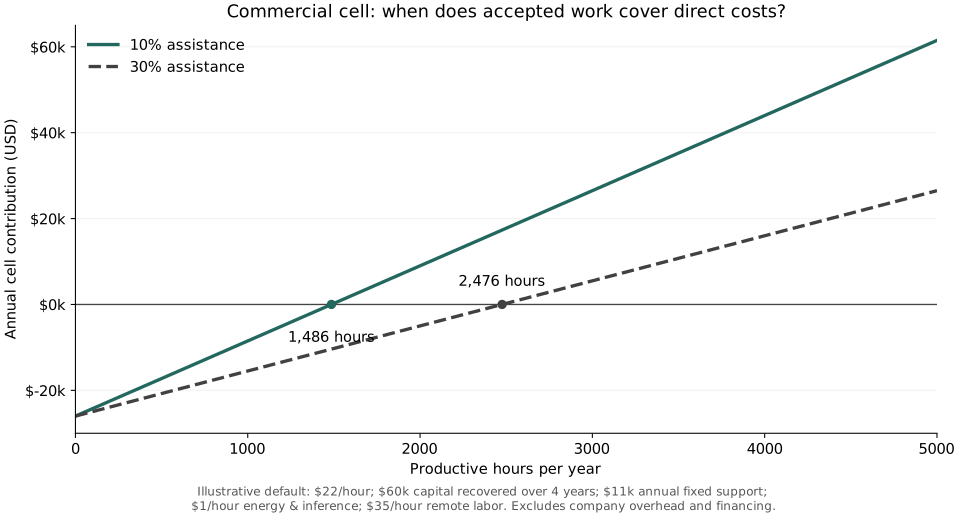
At 4,000 productive hours and 10% assistance, annual cash contribution before capital recovery is $59,000. Dividing $60,000 installed capital by that gives about 1.02 years of capital-only payback, assuming immediate steady operation. This excludes development, financing, tax, working capital, and ramp-up. Do not subtract depreciation again in that cash calculation or interpret it as payback on the whole startup’s investment.
Consumer meals: two distinct comparisons for value
The author’s proposed product is a customized weekly food service: meals that reflect a household’s tastes, portions, dietary preferences, and schedule. The two reference categories are prepared meals/tiffin services and personal-chef service for a family. They are anchors for customer research, not interchangeable products or a guaranteed price interval that the startup can capture.
| Alternative | Public price evidence reviewed 20 November 2026 | What the comparison must preserve |
|---|---|---|
| Prepared meal subscription | Sunbasket’s FAQ advertises meals from $9.99/serving and distinguishes prepared Fresh & Ready meals from kits; free delivery is a first-order offer.[65] | Use the actual prepared-meal basket, recurring fees, portions, protein choices, and delivery ZIP. A starting price is not a 20-meal household quote. |
| Tiffin service | MyTiffin lists a four-item bundle at $25 plus tax, described as one complete meal; delivery is free within its stated 20-mile radius, with an extra charge beyond it.[66] | “Four items” does not mean four meals. Verify geographic coverage, portion size, menu flexibility, and subscription discounts. |
| Weekly in-home personal-chef prep | Eat Cook Joy lists weekly prep from $165 for three mains and two sides, with groceries at cost; rates vary by chef and serving counts are selectable.[67] | Match total adult portions, dishes versus complete meals, groceries, staples, cleanup, and actual Bay Area chef availability. Do not divide by an invented meal count. |
| More extensive personal-chef service | Savvy Dining SF lists sessions from $390 plus groceries and describes typical grocery spend of $100–150/week.[68] | The implied $490–540 at the starting fee is not a quote for a fixed number of meals. Check scope and portions before comparing per-serving prices. |
A dedicated chef preparing fresh meals on demand offers a different service from a weekly batch-prep visit; neither should be used as a blanket proxy for the other. More customization, freshness, discretion, or service can justify higher value for some customers. But less expensive personal-chef prep can overlap with premium delivered meals. The robot service must earn its premium through the experience and retention, rather than assume every household will pay something close to a full-time chef’s cost.
For a transparent comparison, define 20 adult-equivalent portions per ordering week: four people receiving five dinners, not all of a family’s food. At illustrative prices of $13, $20, and $28 per portion, the household spends $260, $400, or $560/week, with delivery included in these scenarios and any applicable taxes excluded. These are proposed price tests, not vendor quotes or measured willingness to pay. Hold ingredients, portion sizes, delivery frequency, cleanup burden, and customization scope constant before calling one offer cheaper or better.
A shared robotic kitchen selling customized meals directly to households
Start with a restricted menu and validated options: portion size, protein, sauce, spice level, and ingredient substitutions supported by the production process. Selection among existing dishes is different from making each household an entirely new recipe. Allergy requirements also need a validated process, not just a language-model instruction. Human chefs and conventional equipment should remain the baseline; a robot earns its place only if it improves the complete food business.
The following illustrative unit model assumes one weekly order with 20 accepted portions. It includes remaining human labor and does not assume that robots cook every step.
| Per-portion or per-order input | Planning assumption |
|---|---|
| Ingredients per accepted portion | $5.00 |
| Variable preparation, finishing, and sanitation labor per portion | $2.00 |
| Packaging per portion | $1.00 |
| Waste, remakes, and refund reserve per accepted portion | $0.75 |
| Energy and inference per portion | $0.25 |
| Extra customization cost per portion | $1.50 |
| Payment-processing rate | 3% of meal revenue |
| Weekly delivery plus order/customer support | $15 + $5 per household order |
| Customer acquisition cost (CAC) | $400 per acquired household |
| Expected paid ordering weeks over the customer relationship | 26; skipped weeks do not count |
| Weekly site fixed costs | $6,000 |
| Accepted production capacity | 2,000 portions/week, equivalent to 100 ordering households |
The $6,000 weekly fixed allowance consists of $3,500 minimum staffing, supervision, and baseline sanitation; $1,000 premises and fixed utilities; $750 equipment capital recovery/maintenance; and $750 site administration/insurance. Variable labor above is additional volume-dependent work: these categories must not double-count the same hours. All figures need quotes and production measurements. Fixed cost is assumed flat only within the stated capacity; another shift or site adds a step in costs.
Let q be portions per household order, p net realized price per portion before payment fees, f the fee rate, v variable portion cost including customization, d delivery/support per order, A acquisition cost, T expected paid ordering weeks, and F weekly site fixed cost. Then:
Household contribution before acquisition = q × [p(1 − f) − v] − d
Household contribution after allocated acquisition, g = q × [p(1 − f) − v] − d − A/T
Weekly site result = N × g − F; break-even ordering households = ceil(F/g), if g > 0
At $20/portion, the $400 order contributes $158 before acquisition, or $142.62 after allocating $400 CAC over 26 paid ordering weeks. Break-even is 43 active ordering households, or 860 accepted portions/week, inside the assumed 2,000-portion capacity. At 60 households, the weekly result is approximately $2,557 after modeled site costs, on $24,000 revenue. This excludes central company R&D/overhead, financing, tax, and expansion expenditure; it is not net profit.
| Proposed price / portion | Household weekly bill | Contribution / ordering household after allocated CAC | Break-even households / week | Within assumed 100-household capacity? |
|---|---|---|---|---|
| $13 | $260 | $6.82 | 881 | No |
| $20 | $400 | $142.62 | 43 | Yes |
| $28 | $560 | $297.82 | 21 | Yes, if that price retains demand |
The table isolates price while holding cost and demand assumptions fixed. In reality a higher price may lower conversion and retention, and a richer service may cost more. The $13 scenario cannot break even at this site’s modeled capacity; extrapolating its line to 881 households without adding kitchens and staff would be misleading.
Interactive figure loading…
Download the default chart · Default chart data · Calculation model.
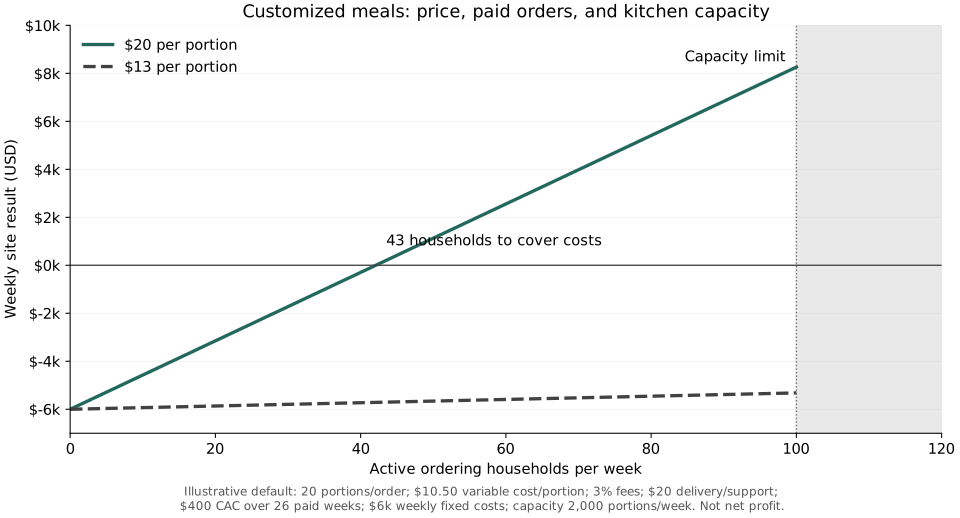
At 60 households, the modeled minimum price is $17.80/portion, from p_min = [v + (d + A/T + F/N)/q]/(1 − f). This is our modeled cost floor, not the customer’s willingness to pay. Raising customization cost from $1.50 to $5/portion pushes the $20 offer’s break-even to 83 households. Reducing expected paid weeks from 26 to 12 pushes it to 49 households. Both changes together would exceed the assumed capacity. A business with rich customization must preserve repeatable production beneath the customer-facing variety.
CAC allocation is not cash timing: the $400 is spent before those future orders arrive. At the base case, simple CAC payback is 400/158 = 2.53 paid ordering weeks before site fixed costs. Early growth still requires kitchen capital, inventory, acquisition cash, and funding for low utilization. Track retained contribution by acquisition cohort and actual paid weeks, not just a blended margin or subscription registrations. Model renewal, pauses, delivery density, discounts, refunds, and household churn before expanding.
An in-home cooking robot with weekly ingredient delivery
This alternative sells a household cooking capability, potentially with an ingredient subscription. It may offer fresher preparation and more immediate customization, but each home ties up a robot and creates installation, cleaning, servicing, and utilization risks. Model the household’s total bill separately from the startup’s device/service contribution; groceries passed through at cost are not software margin.
For an illustrative sensitivity, assume $12,000 installed device cost, 48-month zero-residual life, $80/month support and maintenance, $30/month compute/connectivity, 3% fees on the service subscription, and $600 CAC. Assume 20 portions per week and a separate $7/portion ingredient-and-delivery charge at cost, inclusive of its own processing costs. These are deliberately exposed planning inputs, not a claim that a capable cooking system is available for $12,000.
| Monthly robot/service subscription | Household effective cost / portion, including ingredients | Monthly device/service contribution after capital recovery | Capital + CAC cash payback at steady service |
|---|---|---|---|
| $399 | $11.60 | $27.03 | 45.5 months |
| $699 | $15.07 | $318.03 | 22.2 months |
Calculations use 52 ordering weeks/year: household cost is 7 + subscription × 12/(20 × 52). Monthly contribution is 0.97 × subscription − 12,000/48 − 80 − 30. Capital-plus-CAC cash payback is (12,000 + 600)/(0.97 × subscription − 80 − 30), excluding financing, central overhead, ramp-up, and replacement. The contribution column does not allocate CAC; the payback column explicitly includes its upfront cash. Churn before recovery, failed installations, low use, and retrieval/refurbishment of devices can overturn this result. A customer-paid hardware purchase changes financing and adoption; it does not remove the cost from the household comparison.
How the consumer model changes the opportunity thesis
The earlier cooking rank concerned an in-home appliance. A personalized prepared-meal service is a separate candidate, with consumer demand and shared production economics. It can be tested first with human chefs and existing kitchens, then automate the bottleneck. That experiment can discover whether customers pay for adaptation to each family member, better taste, freshness, or reliable dietary preferences before the company funds general-purpose kitchen manipulation.
Run paid tests of comparable 20-portion baskets at several prices, against both prepared-meal services and a scoped personal-chef quote. Measure repeat orders, actual customization requests, food waste, remakes, delivery cost, kitchen throughput, and contribution. Then compare robotic and human-assisted production at the same quality. Do not force customers into labor-hour pricing, and do not let apparent savings against an expensive private chef conceal a product customers compare with a much cheaper meal subscription.
What $10–15 million should buy
Treat $12.5M as an illustrative equity-funded, 24-month development budget for one product direction. Venture debt and equipment financing are additional options to evaluate; neither is assumed available in this base budget. An average of 12 full-time staff at $250,000 annually fully loaded consumes $6M; these are planning assumptions rather than current compensation quotations.
| Use of funds | Illustrative allocation |
|---|---|
| Team, including integration and field engineering | $6.0M |
| Robot cells, fixtures, spares, and test instrumentation | $1.5M |
| Compute, data collection contractors, and tooling | $0.8M |
| Pilot deployment, customer support, travel, and logistics | $1.2M |
| Facilities, insurance, legal, and administration | $1.0M |
| Contingency and financing runway | $2.0M |
| Total | $12.5M |
At $10M, reduce the average team or pilot scope; do not silently assume the same runway. At $15M, preserve the extra capital until pilot economics identify a repeatable use. The budget does not fund training a frontier foundation model from scratch, developing a new humanoid body, and building a mass-production factory simultaneously. A software-only validation company would have a different allocation.
The seed outcome should be a product that works at multiple independent sites, has paid demand, and becomes easier to install with experience. Plan the financing of repeatable deployments alongside the product. Equity can fund uncertain engineering and initial pilots; equipment finance can conserve equity once deployed assets and customer payments support repayment. Venture debt can separately extend corporate runway. Formic’s RaaS offering is another precedent for combining deployment, service, and financing, and a competitor to a generic automation subscription.[69]
What each financing stage should prove
For this thesis, use the following proposed financing sequence, with milestones defined by evidence rather than round labels. Angel investment and self-funding describe sources of money; pre-seed, seed, and Series A describe stages. They can overlap, and founders do not need to personally finance a production-ready robot before raising institutional capital.
| Stage | What the capital funds | Evidence to establish before the next stage |
|---|---|---|
| Self-funded / angel / pre-seed | Customer discovery, the founding technical team, a narrow prototype, and access to design partners | A specific buyer and painful workflow; credible technical feasibility on representative tasks; an initial price/cost hypothesis; and customers willing to test it. A complete autonomous product is not required. |
| Seed | The initial engineering and field team, a deployable product, first paying production customers, and measurement of installation and support costs | Evidence that customers keep using and paying for the product; useful throughput and reliability; understood intervention costs; and a plausible way to repeat sales and deployments without redesigning each installation. Turn the scaling business plan into a case supported by operating data. |
| Series A | More deployments and customers, repeatable manufacturing and installation, sales capacity, service operations, and continued product improvement | Demonstrate that the working deployment pattern can expand while retaining customers and controlling cost, quality, and cash consumption. Eligible equipment financing may support the fleet alongside equity. |
Seed should establish early repeatability; Series A should expand it. Operations start with the first production customer during seed. Series A builds the capacity and processes to run more of those operations. Neither milestone requires company-wide profitability, and robotics businesses can still carry substantial technical risk at Series A. The unresolved risks should be explicit rather than hidden behind a fleet-growth target.
For our meal-service example, pre-seed can test paid demand with human chefs and an existing kitchen. Seed can validate retention and meal contribution while putting one useful automation step into production. Series A can expand a proven kitchen process or deployment model. An in-home robot requires a different seed test: whether households use and retain the device, and whether installation, cleaning, assistance, and servicing costs permit repeatable deployment.
Chef’s announced facility is a Series A example, so it belongs in the scaling-finance plan rather than the assumed seed budget. Earlier debt is possible: SVB/First Citizens explicitly considers substantial seed rounds, while HSBC’s guidance favors later stages. The deciding factors include the company, contracts, eligible assets, and repayment prospects—not simply the label on the round.[70][71] Keep equipment and venture debt as options to investigate during seed, with the base plan independent of an uncommitted facility.
Chef Robotics: what the financing headline actually means
Chef’s 31 March 2025 announcement reported $43.1M of new financing: $20.6M equity plus $22.5M equipment-financing debt. Its cumulative totals were approximately $65.6M: $38.8M equity and $26.75M equipment financing, all from Silicon Valley Bank, a division of First Citizens Bank. Thus $26.75M was the cumulative equipment figure, not an additional amount on top of that round. These are historical announced financing totals, not evidence of today’s cash or outstanding debt balance.[72]
Yes, this is bank lending: Chef identified the equipment component as debt to finance robots offered through RaaS. In an interview, its CEO described using signed customer contracts to obtain bank funding and repaying the bank monthly or quarterly as customers pay for service.[73][74] The economic purpose is to bridge upfront robot expenditure and later customer receipts while conserving equity for development and growth.
The reviewed announcements do not disclose Chef’s interest rate, maturity, advance percentage, exact collateral and recourse, covenants, warrants, or amount already drawn. A signed contract does not establish automatic eligibility for every draw. Do not infer a revolving line, robot-only collateral, or zero dilution from the headline. Those require the actual financing agreement.
Equipment financing and venture debt serve different purposes
| Capital source | What it can fund | What makes it available and what it costs |
|---|---|---|
| Equity | Product development, uncertain pilots, hiring, and uncovered deployment costs | Investors take ownership and bear the risk that the product never becomes viable; no scheduled loan repayment. |
| Equipment loan or lease | Eligible production equipment or a deployed RaaS fleet | Financing is tied to specified assets and underwriting. A loan requires principal and interest; a lease requires contractual payments and may have an end-of-term purchase or return obligation. Eligible costs may be narrower than total installed cost. |
| Corporate venture debt | Runway or growth expenditure permitted by the agreement | Underwriting emphasizes venture backing, liquidity, milestones, and ability to raise further capital as well as the business. Repayment, covenants, and possible warrants apply; it is not unrestricted equity. |
The labels can overlap: equipment financing to a venture-backed company is sometimes grouped under venture debt. For this thesis, distinguish financing identifiable equipment from borrowing to fund corporate runway. SVB markets venture debt after Series A or a substantial seed round, notes possible warrant dilution, and gives 20–40% of the latest equity round as a common sizing range. Applied mechanically to $12.5M, that is $2.5–5M to discuss, not a promised facility or budget entitlement. HSBC’s guidance is more conservative about seed-stage borrowing. Eligibility is lender- and company-specific.[70:1][71:1]
SVB’s published HaaS example links financing of the bill of materials to committed customer contracts and deployed robots, with repayment over 12–36 months. It illustrates the product, not Chef’s private terms.[75] Confirm whether a lender advances before manufacturing or reimburses after deployment/acceptance; the latter leaves a production cash gap. Also distinguish a facility’s headline limit, the amount currently eligible to draw, and cash actually borrowed. Repayment does not necessarily restore borrowing availability unless the agreement permits it.
Collateral is not synonymous with limited recourse. Trinity advertises equipment-specific liens for its equipment product; other structures may secure broader company assets. Ask about liens, guarantees, restrictions on other borrowing, and priority between lenders. Debt can preserve ownership but still include warrants, fees, or end payments. Less dilution is not the same as less risk.[76]
Who writes these checks
These are documented provider examples and outreach candidates, not indications that they would approve this startup. Ask for the relevant equipment/HaaS or venture-lending team, rather than assuming the bank’s VC investment arm supplies the loan.
- SVB / First Citizens: the disclosed equipment lender to Chef, with a published HaaS lending product and a separate venture-debt offering.[72:1][75:1][70:2]
- Trinity Capital: a specialty lender whose equipment offering explicitly includes robotics and HaaS. Its February 2024 commitment of $20M to autonomous manufacturing company Formlogic funded CNC equipment expansion.[76:1][77]
- Farnam Street: a concrete equipment-lessor precedent in robotics. Serve Robotics’ Q1 2025 filing describes a 2022 financing lease for robot parts and manufacturing, based on an expected $4.46M equipment cost; this is historical evidence, not a current lending offer.[78]
- Stifel Bank and HSBC Innovation Banking: candidates for corporate venture lending. Stifel describes lending from seed stage onward; HSBC’s US offering includes Series A through larger enterprises. Do not assume their corporate loans have the same asset eligibility or security terms as Chef’s facility.[79][80]
Avoid a blanket rule that large banks only lend after several profitable years. J.P. Morgan explicitly markets debt-financing alternatives to venture-funded companies. A startup banking relationship alone still does not establish eligibility for a robot-fleet facility.[81]
Debt service changes the cell’s cash break-even
Apply financing to the earlier $60,000 commercial cell as an illustrative sensitivity, not a lender quote or Chef’s terms. Assume 80% of installed cost is eligible and financed: a $48,000 loan, $12,000 equity contribution, 12% fixed nominal annual interest, and 36 equal monthly payments beginning one month after funding. Assume no fees, warrants, balloon, grace period, or extra working capital. Those simplifying assumptions must be replaced by an actual term sheet.
For loan principal D, monthly rate r, and n payments, payment = D × r / [1 − (1+r)^(-n)]. Here the payment is $1,594/month, or $19,131/year, with approximately $9,394 total interest over three years.
| Operating scenario | Annual cell cash contribution before debt service | Annual cash after principal + interest | Cell cash contribution / debt service |
|---|---|---|---|
| 4,000 productive hours; 10% assistance | $59,000 | $39,869 | 3.08× |
| 4,000 productive hours; 30% assistance | $31,000 | $11,869 | 1.62× |
| 2,000 productive hours; 30% assistance | $10,000 | −$9,131 | 0.52× |
Before-debt cash contribution is H × (22 − 1 − 35a) − 11,000, using the original operating assumptions. Debt-service cash break-even is (11,000 + 19,131.44)/(22 − 1 − 35a): approximately 1,722 productive hours/year at 10% assistance, or 2,870 at 30%. This differs from Figure 1’s economic break-even after capital recovery. The coverage column is a cell-level planning ratio, not a lender-certified corporate debt-service coverage ratio.
Subtract principal and interest in the cash schedule; do not also subtract the $15,000 annual capital-recovery allowance. Principal repayment is not a profit-and-loss expense, while depreciation and interest belong in the accounting view. This cash test excludes recovery of the initial $12,000 equity, corporate overhead, tax, and replacement capital. Debt reduces upfront equity tied up in each cell but makes low utilization or customer cancellation more consequential. Build a monthly deployment-cohort cash forecast to test delayed acceptance, repairs, missed payments, and repayment beginning before revenue.
How financing changes the seed plan and the consumer options
Keep the $12.5M base plan viable without uncommitted credit. Once pilots establish reliability and paid demand, seek a facility against eligible deployments and retain equity for the uncovered portion, development, servicing, and reserves. At the illustrative 80% advance, 100 cells costing $60,000 each would require $4.8M debt plus $1.2M upfront equity, before working capital and fees. That is a conditional financing scenario, not an increase in free operating cash. Do not count the same hardware purchase both in the equity budget and as a new incremental debt-funded purchase.
For B2B RaaS, test contract duration, minimum payments, customer credit, acceptance conditions, redeployability, and cash remaining after service against loan repayment. For a shared consumer meal kitchen, equipment finance may help purchase eligible kitchen machinery, but customer acquisition, ingredients, delivery, and recipe development still need funding; cancellable weekly orders are a weaker repayment commitment than a long enterprise contract. For an in-home cooking subscription, distributed servicing, churn, retrieval costs, and uncertain resale value are additional underwriting questions. These are our proposed financing tests, not claims about a lender’s decision.
The seed milestone should therefore include evidence that repeated installations can qualify for financing: measured operating cash generation, durable contracts or retention, a documented bill of materials, asset ownership, useful life, and a downside repayment plan. A lender term sheet can materially change the equity needed for scaling; an announced debt total elsewhere cannot substitute for one.
A route to scale, with the arithmetic exposed
At the illustrative $88,000 annual revenue per cell, 1,200 fully utilized cells would produce $105.6M annual service revenue. At $60,000 installed cost each, that fleet represents $72M of initial hardware expenditure before replacements and corporate spending. These are scale checks, not market sizing or valuation predictions. Revenue quality, margins, retention, growth, capital needs, and market conditions determine whether investors assign a billion-dollar valuation.
For a software alternative, $100M annual recurring revenue would require, for example, 1,000 customers paying $100,000 each, or 200 paying $500,000. That arithmetic forces a difficult question: are there enough robot operators with that budget and a problem we can repeatedly solve? The next research pass should build a bottom-up customer count and achievable contract value from an identified segment; a broad robotics market forecast is inadequate.
A plausible application expansion is one cell → adjacent tasks at the same site → repeated installations across a customer’s network → related customers. Do not add unrelated capabilities merely to resemble a general-purpose robot. A standardized process, sales channel, service network, and accepted-output history can be more defensible than a particular model checkpoint.
Who captures the value
The notes ask whether robotics will resemble an Apple-style integrated platform, an Android/Windows-style ecosystem, or an automotive manufacturer with a durable lead. Treat these as alternative scenarios rather than predictions.
| Scenario | Exposure for an application startup | Strategic response |
|---|---|---|
| Integrated robot vendors own core applications | The platform may absorb popular tasks and restrict access | Own a demanding vertical workflow and customer relationship; secure commercial access terms |
| Open hardware and interchangeable models proliferate | Basic robot control becomes inexpensive and widely available | Build on portable interfaces; differentiate on accepted output, deployment, and service |
| Fragmented industrial systems persist | Integration remains valuable but labor-intensive | Productize a narrow installation recipe; measure engineering hours per deployment |
The preferred opportunity should survive all three reasonably well. Avoid dependence on one unreleased robot or a privileged model partnership. Verify data rights and exportability, model availability and latency, access to control and diagnostics, warranties, supply continuity, and whether the hardware supplier can offer the same workflow directly. Customer-specific knowledge may remain valuable even as general robot skill becomes cheaper.
VCs to look at
The relevant distinction is the kind of robotics company a fund is prepared to underwrite: a research-heavy intelligence platform, a complete robot system, a vertical application with operating revenue, or the infrastructure used by other robotics companies. Public investments establish relevant experience; they do not establish current appetite, available checks, or willingness to lead this particular $10–15M seed. The fit assessments below are our inferences from cited strategies and investments, not statements from the firms about this proposal.
Large technology investors with explicit physical-AI exposure
Andreessen Horowitz (a16z). Its August 2026 Machine Age Fund announcement describes a $1.1B vehicle spanning AI infrastructure, robotics, and home AI appliances. Oliver Hsu’s April 2026 essay emphasizes physical-world models, simulation, and emerging interfaces.[82][83] This is a broader investment approach than industrial automation alone. Potential fit: a differentiated robot product, enabling infrastructure, or an application with a credible path to becoming a large business. Prepare a specific explanation of what the startup controls beyond access to improving models; identify the relevant investing team rather than treating the firm’s several strategies as interchangeable.
Sequoia Capital. Its company pages identify investments in Physical Intelligence and Skild AI, with Alfred Lin and Stephanie Zhan respectively listed as partners. Its October 2026 Mecka investment essay extends the thesis to data collection, reinforcement learning, and deployment operations.[84][85][86] Potential fit: a technically exceptional platform or a data/deployment business with a durable advantage. For a narrow application, explain why customer access and accumulated operational knowledge support expansion. These holdings also make portfolio overlap an explicit screening question; funding foundational models does not imply that another foundation-model startup is the right pitch.
Khosla Ventures. Its stated approach welcomes unconventional technical bets while emphasizing short innovation cycles and inexpensive removal of clearly identified risks. Its portfolio includes Reflex Robotics, Rhoda, Vayu, and Opentrons.[87][88] Potential fit: a large long-term physical-work opportunity with an unusually efficient technical path to the first proof. The useful pitch is a major ambition paired with a sequence of falsifiable experiments. Its portfolio spans embodiments and applications, so do not reduce the thesis to humanoids or assume that the firm requires a newly designed body.
Founders Fund. Its longstanding manifesto favors ambitious technical advances, while its disclosed portfolio includes Anduril and other substantial physical-system businesses.[89][90] This supports investigating fit for a consequential systems company; it is less direct evidence of a current mandate for an incremental warehouse retrofit. Show the durable advantage and why a narrow first application can lead to a much larger company. The older manifesto is useful philosophical context, not a current robotics market report or proof of seed terms.
Investors combining technical depth with deployment economics
Lux Capital. Lux identifies Formic as a portfolio company and reported backing Physical Intelligence in 2024.[91][92] That spans managed industrial automation and foundational robot intelligence. Potential fit: a hard technical advantage connected to a defensible deployment or financing model. For a service-based cell company, distinguish revenue, contribution, and fleet-capital requirements. Formic is also a possible competitive overlap, so a generic automation subscription is a weak differentiation story.
Eclipse. The firm’s physical-industry portfolio is relevant to manufacturing and deployment; its 17 November 2026 Genesis AI essay explicitly argues that general-purpose robotics requires an integrated system of simulation, data, models, hardware, and manufacturing.[93][94] Potential fit: an application or system whose design and deployment economics improve together. This is a useful challenge to our buy-the-hardware recommendation: explain which interfaces the startup must control and why purchased arms preserve that control. Eclipse’s participation in large platform rounds does not mean this seed company should copy their capital plan.
DCVC. Its portfolio includes Agility Robotics and other physical technology businesses.[95] Potential fit: a technical advantage that produces measurable operating value and can survive commercialization. Prepare the evidence for why the chosen sensing, control, tooling, or data capability is difficult to reproduce, rather than relying on a general robotics label. The portfolio supports relevance; current partner ownership, stage, and competitive conflicts still need verification.
Construct Capital. Its stated focus is early-stage investment in foundational industries.[96] Potential fit: a repeatable product for an existing industrial buyer, with a clear distribution and adoption plan. For returns or dishroom handling, bring the workflow’s actual budget owner, purchase process, and second-site installation plan. This is a stronger fit hypothesis for a vertical commercial application than for an unconstrained home-helper research program.
Software, seed-stage engineering, and enabling infrastructure
Bessemer Venture Partners. Bessemer lists Foxglove in robotics observability and data management; ANYbotics names it as a participant in its 2023 Series B.[97][98] That provides evidence across developer infrastructure and industrial inspection. Potential fit: recurring software value or a deployment business with clear enterprise economics. A new reliability tool must articulate its difference from Foxglove; a prior Series B investment does not establish willingness to lead a seed.
Emergence Capital. Its Physical Intelligence investment essay links robot intelligence to making deployment easier and changing physical work, extending the firm’s stated focus on technologies that transform work.[99] Potential fit: robotics software or an application whose recurring value comes from improved work outcomes. Bring a credible enterprise buyer and expansion path, while treating its investment in a frontier model company as evidence of interest rather than a template for this budget.
Root Ventures. Its deep-tech seed focus and robotics portfolio make it a relevant early technical discussion partner.[100] Potential fit: a compact engineering team with a hard problem, a credible prototype plan, and a disciplined use of seed capital. Verify the desired role and check size directly; do not assume one specialist seed fund supplies the entire round.
SOSV / HAX. HAX combines hard-tech investment with engineering and commercialization support.[101] Potential fit: a new end effector, actuator, appliance, or other product where manufacturing development is a central risk. Evaluate the practical support, program terms, and stage fit rather than listing it as interchangeable with a large institutional seed lead.
Matching the fundraising approach to the chosen company
For the currently preferred commercial application, start fit research with Eclipse, Construct, Lux, and DCVC, alongside Root for early engineering feedback; include a16z and Khosla where the technical advantage and expansion case are strong. For reliability software, investigate Bessemer, Emergence, Sequoia’s data/deployment work, and a16z, while mapping portfolio conflicts. For a consumer appliance or new hardware component, investigate Khosla, Lux, Root, HAX, and a16z’s hardware strategies. These are proposed conversation priorities, not rankings of investor quality or predictions of investment.
The initial materials should include the manual baseline, an entire completed workflow, incumbent and Chinese-hardware comparisons, paid customer evidence, intervention economics, and the milestone this round funds. Explain how the business avoids the historical failure modes above. A $10–15M round size is a financing assumption to justify, not a reason to broaden the product until it requires that amount.
San Francisco helps with introductions, talent, demonstrations, and proximity to some investors. Its practical value is faster diligence and learning, not proof of demand. No outreach has been sent. Before sharing sensitive technical or customer material, identify the relevant partner, current stage mandate, decision process, and direct portfolio conflicts. Actual check sizes, ownership targets, follow-on reserves, and current interest remain unverified.
Proposed validation plan
First 30 days: choose the workflow
Conduct approximately 15–20 operator interviews and at least six site visits across the top two application candidates, plus a small set of robot OEM/integrator interviews for the tooling alternative. These are proposed targets. Obtain representative shift observations, current costs, procurement constraints, failed automation attempts, and permission to use the needed data. Ask who signs, what acceptance means, and what would cause cancellation. Select one direction; keep the other as a documented alternative.
Days 31–90: compare complete systems
Build a constrained prototype on purchased hardware and compare it with the simplest fixture-based baseline. Run the same held-out task set across conventional control, frontier-agent control, a task-adapted VLA, and the hybrid approach. Log human preparation and recovery. Seek two paid pilots with written acceptance criteria; letters of interest without operating access are weak evidence.
Months 4–12: prove repeatability
Aim for three to five independent customer sites, with one meaningful held-out site rather than copies of the lab. Proposed commercial gates are at least 20% customer savings after retained labor and site costs; a credible path to 40% contribution after fully allocated direct costs; and declining installation and intervention effort. These are targets to negotiate and test, not industry standards. Track full-shift throughput, customer acceptance, renewals or expansion orders, and all failure modes.
Months 12–24: earn the right to scale
Expand only when the system can be installed from a repeatable process, supported within the modeled cost, and financed without starving product development. Add adjacent work that improves utilization or increases revenue from existing customers. A Series A story should rest on a cohort of paid deployments and a credible sales pipeline, not one exceptional demonstration.
Questions that could change the thesis
The next iteration should establish the founder’s strongest technical and commercial advantages; willingness to run field service and hardware operations; access to warehouse, laundry, kitchen, or construction customers; and preference for an application business versus infrastructure. More research is needed on actual customer counts, comparative quotes, hardware supply terms, field failure distributions, and real willingness to pay.
The current recommendation is to spend the first discovery cycle on restricted hard-goods returns processing, with institutional dishroom handling as the comparison candidate. Select one for the prototype after site observations and incumbent quotes; do not split the seed team between both. Commercial laundry is third unless a customer reveals a specific unmet requirement. If the founder chooses consumer applications instead, investigate a stationary laundry appliance first, with household economics and direct competition as the deciding tests. Reliability tooling remains a separately financed alternative rather than a side product assumed to have buyers.
References
Sources below were accessed on 20 November 2026. Mutable product and benchmark pages describe the state observed on that date. References are primary sources unless identified otherwise; vendor reports retain their commercial incentives.
U.S. Bureau of Labor Statistics. American Time Use Survey: 2025 results, 2026. Release and tables. ↩︎
Kim, Pertsch, Karamcheti et al. OpenVLA: An Open-Source Vision-Language-Action Model, 2024. Project, paper, code, and models. ↩︎
Physical Intelligence. π0: Our First Generalist Policy, 31 October 2024. Research article. ↩︎
Physical Intelligence. π0.5: A VLA with Open-World Generalization, 22 April 2025. Research article and paper. ↩︎
Physical Intelligence. π0.6: A VLA that Learns from Experience*, 17 November 2025. Research article and paper. ↩︎
Physical Intelligence. OpenPI. Official source repository. ↩︎
Robocurve. Real-world evaluations of physical AI, live RoboDojo-RC Tier 1 results. Benchmark operator. ↩︎ ↩︎
Machcha, Menon, Zou, Chan, and Chooi, Robocurve. Opus 5.5 on RoboDojo-RC Tier 1: higher scores at lower cost, 23 September 2026. Task selection, rubrics, and limitations. ↩︎
Anthropic. Introducing Claude Fable 5.2 and Claude Mythos 5.2, 9 November 2026. Release and evaluation details. ↩︎
Gruenstein and Cohen, Google. Gemini 4 Hydrogen: a faster model for general purpose robotics, 17 November 2026. Robotics workbench and demonstrations. ↩︎
OpenAI. Introducing GPT-6.2 Astra and Sol, 17 November 2026. Release. ↩︎
Artificial Analysis. Welcome to the era of embodied AI: Introducing AA-Robotics v0.1, 14 October 2026. Methods, tasks, scores, time, and cost. ↩︎
Google DeepMind. Gemini Robotics On-Device brings AI to local robotic devices, 2025. Research announcement. ↩︎
Physical Intelligence. Real-Time Action Chunking with Large Models, 2025. Research and paper. ↩︎
Ambi Robotics. Ambi Robotics Introduces AmbiStack, 28 January 2025. Product announcement. ↩︎
Plus One Robotics. Human-in-the-Loop. Yonder product description. ↩︎
GXO. GXO signs industry-first multi-year agreement with Agility Robotics, 2024. Customer announcement. ↩︎
HOBART. Fully-automatic systems. Existing dirty- and clean-side automation. ↩︎
MEIKO. M-iFlow IPB. Dishroom automation module. ↩︎
Yaskawa. Yaskawa & Meiko: Automatic clearing of used dishes in commercial kitchen dishwater lines, demonstration. Manufacturer video. ↩︎
Dyna Robotics. Dyna-2.1: A Physical Agent for End-to-End Workflows, 29 September 2026. Research and workflow description. ↩︎
Weave Robotics. Isaac 0. Product and shipping claims. ↩︎ ↩︎
Laundry Robotics. Solutions and products. Official site. ↩︎
Dusty Robotics. BIM to Field Layout: From Model to Slab, 2026. Workflow description. ↩︎
Gecko Robotics. About us. Company history and June 2025 financing disclosure. ↩︎
Chef Robotics. Physical AI for the food industry. Product description and customer examples. ↩︎
Dishcare. Dishcare loads, cleans & puts away dishes. Product claims. ↩︎ ↩︎
Sunday Robotics. Memo and Technology. Product and technical description. ↩︎
1X. NEO Home Robot. Product and Expert Mode description. ↩︎
Foxglove. Data Platform. Official documentation. ↩︎
Intrinsic. Flowstate. Product description. ↩︎
Robocurve. Robocurve raises $10M to independently evaluate frontier AI in the physical world, 14 September 2026. Company announcement. ↩︎
International Energy Agency. Global EV Outlook 2026: Manufacturing and trade, 2026. Supply-chain analysis. ↩︎
HEBI Robotics. Hardware documentation. Actuators and interfaces. ↩︎
Kollmorgen. Humanoid Robots. Frameless motor offering. ↩︎
Hello Robot. Buy Stretch 4. Current product, price, and terms. ↩︎
Hello Robot. Stretch 4 Mobile Manipulator Data Sheet, Rev. 4. Kinematics, reach, payload, and integrated equipment. ↩︎
Unitree. R1-7a Bionic 7 Axis Dexterous Robotic Arm. Official store and configuration selector. Prices refer to standard commercial listings, not student variants or pedestal-only accessories. ↩︎ ↩︎
Unitree. Bionic 7Axis Dexterous Robotic Arm. Official parameters. Official control repository. ↩︎
UFACTORY. Official global store. Prices are mutable listings rather than a delivered system quote. ↩︎ ↩︎
UFACTORY. Lite 6. Global product and specifications. ↩︎
UFACTORY. xArm 6. Configuration, specifications, price, and EXW terms. ↩︎ ↩︎
UFACTORY. xArm 7. Specifications and configurations. ↩︎
AgileX. PiPER 6-DoF Lightweight Robotic Arm. Official specifications and limitations. A current complete price was not visible on the reviewed page. ↩︎ ↩︎
AgileX. NERO 7-DoF Humanoid Robot Arm. Official specifications. Obtain a current configuration-specific quote. ↩︎
Unitree. Z1. Official store price and Air/Pro specifications. ↩︎
Unitree. R1-A / R1-A-D. Official store configuration prices and EDU inquiry and model comparison. ↩︎
Unitree. G1-A / G1-D. Official configuration comparison. ↩︎
AgileX. COBOT MAGIC. Integrated mobile bimanual teleoperation platform. ↩︎
Unitree. G1. Official store and base-versus-EDU development restriction. ↩︎
iRobot. Fiscal 2024 Form 10-K, filed 12 March 2025. Financial results, competition, sourcing, and risk disclosures. ↩︎
iRobot. Form 8-K: restructuring support agreement and Chapter 11 filing, 14 December 2025. Plan and proposed treatment of common equity. ↩︎
iRobot. iRobot Completes Court-Supervised Transaction with Picea, 23 January 2026. Company announcement filed with the SEC. ↩︎
ANKI Help Center. About ANKI. Original company’s 2019 closure and subsequent product support. ↩︎
Hilco Streambank. Anki. Asset-sale case history from the sale adviser. ↩︎
Digital Dream Labs. Digital Dream Labs Acquires Anki Robotics & Artificial Intelligence Assets, 15 January 2020. Buyer announcement. ↩︎
Bosch Business Innovations. Exit story of Mayfield Robotics. Sponsor’s account of need-finding and product evolution. ↩︎
Mayfield Robotics / KuriRobot. Kuri Documentation. Team’s engineering repository and shutdown acknowledgment. ↩︎
O’Brien, Chris. Rethink Robotics’ assets bought by Hahn, Universal Robots hires 20 employees from pioneering firm, VentureBeat, 13 November 2018. Contemporaneous secondary reporting on the original company’s closure. ↩︎
Rethink Robotics / HAHN Group. Sawyer BLACK Edition brochure. Manufacturer’s account of the October 2018 asset acquisition and subsequent hardware revision, hosted by RobotShop. ↩︎
Primack, Dan. Robot-made pizza company raising $50 million, Axios, 2017. Contemporaneous secondary description of the original business. ↩︎
ABB. ABB and Zume to accelerate transition away from single use plastics, 17 November 2021. Partner announcement. ↩︎
Tiger Group. Online Auction Features Uninstalled and Never-Used Equipment from Global Molded-Pulp Packaging Manufacturer, 10 August 2023. Auctioneer’s announcement of Zume asset sales. ↩︎
Seltz-Axmacher, Stefan. The End of Starsky Robotics, 2020. Founder’s retrospective. ↩︎
Sunbasket. Frequently Asked Questions. Meal formats, advertised starting price, and first-order delivery terms. Accessed 20 November 2026; a starting price is not a current ZIP-specific basket quote. ↩︎
MyTiffin. How to Order. Four-item single-person bundle and delivery radius. Accessed 20 November 2026. ↩︎
Eat Cook Joy. Personal Chef Pricing. Weekly prep scope, starting fee, groceries, and cleanup. Accessed 20 November 2026; actual chef pricing and availability vary. ↩︎
Savvy Dining SF. Service — San Francisco. Starting personal-chef fee and indicative grocery spend. Accessed 20 November 2026; portions require a scoped quote. ↩︎
Formic. The Next Chapter, 2024. Deployment, support, and financing model. ↩︎
Silicon Valley Bank. Accelerate Growth with Venture Debt Financing. Product description, eligibility, sizing guidance, and warrants. Accessed 20 November 2026; indicative marketing guidance, subject to underwriting. ↩︎ ↩︎ ↩︎
HSBC Innovation Banking. Is venture debt funding right for your business? Venture backing, unit economics, and stage considerations. Accessed 20 November 2026. ↩︎ ↩︎
Chef Robotics. Chef Robotics Announces $43M Series A Round Led by Avataar Ventures to Scale the Deployment of AI-Enabled Robotics. Company release, 31 March 2025. Round split and cumulative equipment financing from SVB. ↩︎ ↩︎
Chef Robotics. We’ve Raised a $43.1M Series A to Accelerate Our AI-Enabled Robot Deployments. 31 March 2025. Company explanation of debt for its RaaS systems. ↩︎
Elaine Watson. Breaking: Chef Robotics raises $43m Series A to scale AI-enabled robotics in meal assembly. AgFunderNews, 31 March 2025. CEO’s explanation of contract-backed financing and repayments. Interview evidence, not a published credit agreement. ↩︎
Silicon Valley Bank. Hardware-as-a-Service (HaaS) Lending. Product sheet, ©2024. Contract-linked bill-of-materials financing and illustrative repayment process. Indexed product text reviewed 20 November 2026; describes an example, not Chef’s agreement or a current credit commitment. ↩︎ ↩︎
Trinity Capital. Equipment Financing. Robotics/HaaS, equipment-specific liens, and draw-based funding. Accessed 20 November 2026. ↩︎ ↩︎
Trinity Capital. Trinity Capital Inc. Provides $20 Million Equipment Financing to Formlogic. 7 February 2024. Lender announcement. ↩︎
Serve Robotics. Form 10-Q for the quarter ended 31 March 2025, filed 8 May 2025, “Indebtedness.” Farnam Street equipment financing lease disclosure. Historical agreement was subsequently modified; not a current lender quote. ↩︎
Stifel Bank. Venture Banking Capabilities. Seed-to-later-stage lending. Accessed 20 November 2026. ↩︎
HSBC. HSBC U.S. Innovation Banking Expands Venture Debt Offering. 24 August 2023. US offering from Series A onward. ↩︎
J.P. Morgan. Startup Banking. Financing alternatives for venture-funded companies. Accessed 20 November 2026; not evidence of approval for a particular robotics startup. ↩︎
Horowitz, Casado, Raghuram, Ulevitch, and George. The Machine Age Fund, a16z, 28 August 2026. Fund scope and announcement. ↩︎
Hsu, Oliver. Frontier Systems for the Physical World, a16z, 15 April 2026. Published investment perspective. ↩︎
Sequoia Capital. Physical Intelligence. Portfolio and partner. ↩︎
Sequoia Capital. Skild AI. Portfolio and partner. ↩︎
Biad, Anas, and James Flynn. Partnering with Mecka: Bringing AI to the Physical World, Sequoia Capital, 7 October 2026. Data and deployment investment thesis. ↩︎
Khosla Ventures. What We Work On. Investment approach and risk reduction. ↩︎
Khosla Ventures. Official portfolio. ↩︎
Gibney, Bruce. What happened to the future?, Founders Fund. Historical investment manifesto. Its historical market statistics are not used as current robotics evidence. ↩︎
Founders Fund. Disclosed portfolio. ↩︎
Lux Capital. Formic. Portfolio and automation business description. ↩︎
Lux Capital. Lux Q1 2024 Report. Physical Intelligence investment discussion. ↩︎
Eclipse. Investment portfolio. ↩︎
Mwangi, Charly. General-Purpose Robotics Is a Systems Problem, Eclipse, 17 November 2026. Genesis AI investment and integrated-system thesis. ↩︎
Construct Capital. Investment focus. ↩︎
ANYbotics. ANYbotics Secures $50M Series B Funding, 16 May 2023. Investors and industrial deployment rationale. ↩︎
Emergence Capital. Laying the Foundation for a Billion Robots: Our Investment in Physical Intelligence. Published investment thesis. ↩︎
Root Ventures. Fund focus and portfolio. ↩︎
SOSV / HAX. Hard-tech program. ↩︎